|
|
July 1998ON THE ROAD TO PRECISION FARMING - It All Begins With Yield MonitoringTo achieve success in this new information age, farm managers need site-specific information describing the variability of important factors, including crop yield and crop quality. If one is to practice adjustable rate application of inputs, then site-specific crop yield and crop quality reflect the response to these inputs. The basic components of a grain yield monitor are the grain flow sensor, grain moisture sensor, ground speed sensor, and the processing and display module. The most common type of grain flow sensor in the U.S. places an impact plate in the path of the grain flow and measures the force of the grain impact, or the movement (displacement) of the plate due to grain impact. The displacement type of sensor is used by John Deere; the force sensor by Case-IH, Ag Leader and Micro-Trak.
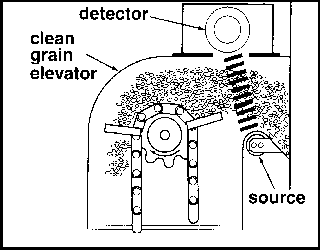
Another type of grain flow sensor is the transmitter - receiver design. This sensor is often used in Europe, and is used by AGCO.
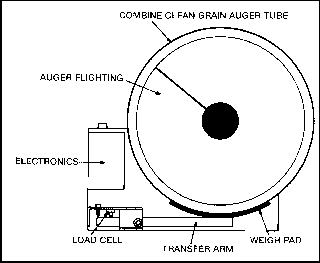
The grain flow monitor from Technological Solutions International uses a weighing system connected to the clean grain auger.
Grain moisture sensors are typically capacitance sensors, similar in operation to most commonly used moisture meters. The di-electric property of the grain between the sensor and the frame is measured and correlated to grain moisture. These types of moisture measurement systems are most accurate at moistures below 25% wet basis. Ground speed sensors are either radar or ultrasonic type. The measured ground speed is typically used along with a swath width specified by the user to compute the area covered per unit time (acreage rate). The acreage rate is combined with the output from the grain flow sensor (bushels per hour) and then adjusted for the measured moisture. The result is the site-specific (about every second) yield measurement. These measurements are stored by the processing module, and can be recalled for transfer to an office computer for analysis. Part of the measurement system includes a header position sensor so that calculations are suspended when the header is in the raised position. |
|
|